


Expertise and sophisticated technologies - our approach to more sustainability in plant nutrition
At COMPO EXPERT, sustainability is a key pillar of our corporate strategy, shaping the way we do business at every step of our value chain. As a global leader in specialty fertilizers and biostimulants, we are committed to enhancing agricultural productivity while minimizing environmental impact. By developing innovative and efficient solutions, we help to ensure healthy crops, higher yields, and long-term soil fertility.
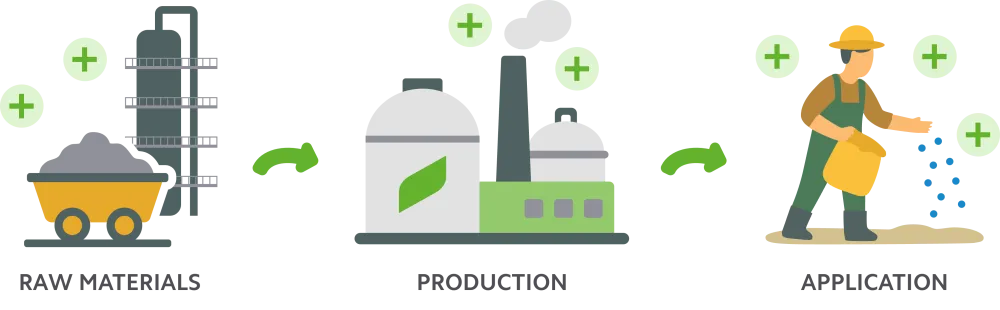
Enabling sustainable growth means helping farmers and growers get the most out of every input, producing higher yields while using resources more efficiently. By combining practical expertise with smart solutions, we support stronger, more resilient, and sustainable agricultural systems.

Nutrient use efficiency
Nutrient use efficiency (NUE) is central to sustainable fertilization because it determines how much of the nutrients applied actually reach and benefit the crop, versus how much is lost to the environment. Low NUE means nutrients leach into waterways, volatilize into the air, or run off – contributing to water pollution, eutrophication, and greenhouse gas emissions like nitrous oxide.
Beyond environmental impact, NUE matters economically: wasted fertilizer is wasted money, making inefficient use a direct cost to farmers. It also affects long-term soil health, since balanced nutrient cycling helps maintain fertility rather than depleting it.
Our slow-release, controlled-release, and N-stabilization technologies ensure a continuous supply of nutrients to the plant, tailored to its needs. While slow-release and controlled-release fertilizers release nutrients in sync with plant growth, depending on temperature and moisture, nitrification inhibitors specifically delay microbial conversion processes in the soil. By the use of these products, nutrient uptake is maximized and the rate of loss due to leaching or gaseous emissions is minimized.

Greenhouse gas emissions
Greenhouse gas emissions happen at every stage of the fertilizer life cycle, but application is a key stage. When crops don't absorb all the nitrogen applied, soil microbes convert parts of the leftover into nitrous oxide (N₂O), a greenhouse gas far more potent than CO₂. How much N₂O is released depends largely on application practices: how much fertilizer is used, when it's applied, and how closely it matches what the crop actually needs.
Products, equipped with nitrification inhibitors, such as our NovaTec® line of products have the nitrogen stabilized in plant-available form. As a result, a larger proportion of nitrogen can be taken up by the plant, which reduces gaseous losses in form of nitrous oxide by an average of 44% (D. Grados et al., Environmental Research Letters, 2022).

Water use efficiency
Water efficiency is a cornerstone of sustainable agriculture, as it directly affects both resource conservation and the environmental impact of farming practices. Water-soluble, fertigation-compatible fertilizer formulations support this goal by dissolving fully and distributing evenly when applied together with irrigation water. This allows nutrients to be applied alongside the water a crop already receives, enabling more targeted fertilization and, within a well-managed irrigation program, reducing nutrient losses through runoff.
By combining water and nutrient delivery in this way, evaporation losses are minimized and nutrients are far less likely to be leached into deeper soil layers or nearby water bodies – helping conserve water while reducing environmental pollution.

Biostimulants
Biostimulants are substances or microorganisms applied to plants or soil that are intended to support processes such as nutrient uptake efficiency and tolerance to abiotic stress (for example heat or drought). They are generally applied to complement the fertilization program and help ensure the efficient use of resources. By helping crops maintain stable yields under stress, biostimulants reduce the need for supplemental water, fertilizer, and land expansion to compensate for losses – thereby lowering agriculture's environmental footprint while also protecting farmer income and profitability against unpredictable growing conditions.

Expert consulting
Agronomic advisory support connects field-specific information, such as soil analysis results, crop requirements, and local growing conditions, with practical recommendations on product choice, timing, and dosage. Our expert advisors are especially trained to help end-users make more informed fertilization decisions based on their specific situation rather than on generic recommendations. By replacing generic recommendations with this tailored, data-driven approach, fertilization becomes more precise and efficient, reducing the risk of over-application, minimizing nutrient losses to soil and water, and ensuring that resources are used only where and when the crop actually needs them.

Digital tools
Digital tools like COMPO EXPERT's FarmHub® and TurfHub® are reshaping fertilization into a far more precise and resource-conscious practice. Rather than relying on generic or calendar-based application schedules, both platforms build recommendations from actual field conditions: crop nutrient needs, soil conditions and soil analysis feed into fertilization plans that flex as conditions change through the season. This data-driven approach cuts down on both over- and under-fertilization, since users can centrally store historical data to monitor and compare nutrient supply across fields and optimize growth over time. Together, these features mean fertilization decisions are grounded in real, current data instead of guesswork, reducing unnecessary nutrient inputs, minimizing runoff and waste, and supporting healthier soils and crops over the long term.

The carbon footprint of a crop is a valuable indicator of the production efficiency in everyday practice. It reveals how effectively inputs such as fertilizers, plant protection products, energy, and machinery are converted into yield. A low carbon footprint generally indicates that resources are being used optimally: nutrients are efficiently delivered to the plant at the right dose and time, fuel and electricity consumption are reduced to the optimum, and unnecessary emissions are avoided. Farmers can achieve this through precision fertilization, the use of modern biostimulants, or optimized soil management. In this way, they not only secure yields but also lower greenhouse gas emissions. The carbon footprint thus combines two key goals of modern agriculture: economic efficiency and ecological sustainability. It serves as a practical management tool, helping farms to identify strengths, target improvements, and remain competitive in the long term.
COMPO EXPERT supports the aim for higher efficiency and lower carbon footprints across the entire value chain. Users of our products can choose, for example, low-carbon fertilizers, products designed for enhanced nutrient use efficiency or biostimulants for improved resilience. Combined with expert consulting and supported by digital tools and soil analysis, we help end-users optimize resource use, reduce losses, and make informed decisions that benefit both yields and the environment.
Every step of fertilizer production can be optimized to reduce its environmental footprint. By focusing on low-carbon raw materials, renewable electricity, and circular solutions, we create products that are both effective for farmers and gentler on the environment.


Low-carbon raw materials
Since 2024, COMPO EXPERT has been using low-carbon raw materials to reduce the carbon footprint of many specialty fertilizers for the Central European market. We have achieved a significant carbon footprint reduction for those products using low-carbon sources of nitrogen, potassium, magnesium, and sulfur, while ensuring the accustomed high performance of our products. The carbon footprint reduction of those raw materials are achieved through the use of renewable energy and/or advanced technologies for carbon capture.
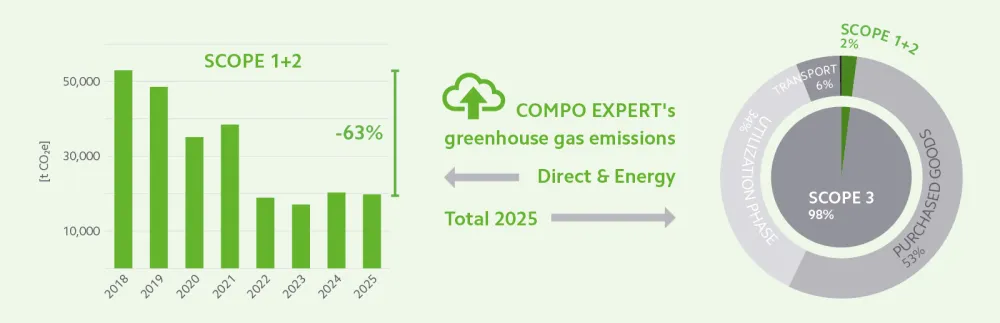
Compared to the production with conventional raw materials, these measures save around 35,000 tons of CO2e — almost twice the amount of COMPO EXPERT´s direct greenhouse gas emissions. This not only significantly reduces our company carbon footprint, but it is also an important lever for end-users to reduce the carbon footprint of their business or product through actual emissions reduction in the value chain.

Recycled phosphate
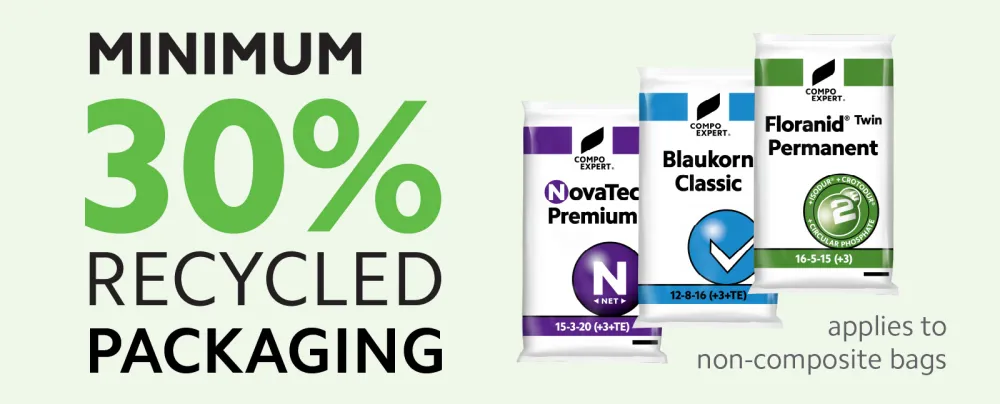
Phosphorus is one of the three essential macronutrients for plant growth, yet the raw rock phosphate it traditionally comes from is a finite resource, geographically concentrated in just a handful of countries and increasingly subject to supply and sustainability pressures. Recovering phosphorus from waste streams such as sewage sludge is a more resource-efficient alternative to mined rock phosphate: it closes the nutrient loop and reduces dependence on a finite, geographically concentrated resource. COMPO EXPERT is actively driving this shift with the relaunch of Floranid® Twin Permanent. This slow-release fertilizer now contains recycled phosphate as a raw material while preserving the reliable, long-lasting nutrient release. Combined with lower-carbon sources for nitrogen and potassium, it is the first fertilizer to combine more sustainable sources for all three main nutrients – N, P, and K.

Renewable electricity
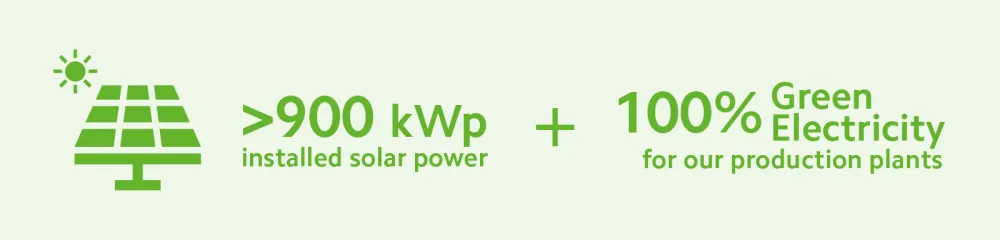
Fertilizers are stored in large warehouses to protect them against moisture and UV radiation. In 2023 we have started to utilize the roof areas of these warehouses by installing photovoltaic systems, first at our plant in La Vall d’Uixó (Spain) followed by our Deinze (Belgium) and Patras (Greece) logistics centers, with a cumulative power of around 935 kWp. To supplement our self-generated renewable electricity, we purchase electricity from 100% renewable sources for several of our sites.

Product life-cycle management
COMPO EXPERT uses the product carbon footprint methodology according to ISO standard 14067 requirements to provide data for more than 250 products, fostering transparency, collaboration, and decarbonization efforts along the agricultural value chain. Providing product carbon footprints enhances transparency by giving clear insights into the greenhouse gas emissions associated with each product's life cycle. This information allows end users to make informed decisions and align purchasing choices with their sustainability goals.
To ensure the expected quality of our products and the systematic reduction of emissions and energy consumption, COMPO EXPERT holds certificates for the three management standards, ISO 9001 (Quality management), ISO 14001 (Environmental management), and ISO 50001 (Energy management, only for Krefeld plant) covering COMPO EXPERT’s production sites.

COMPO EXPERT joins UN Global Compact

We are pleased to announce that COMPO EXPERT has joined the United Nations Global Compact, a voluntary leadership platform for the development, implementation, and disclosure of responsible business practices. With this announcement, we commit ourselves to the 10 principles and the Sustainable Development Goals (SDG). This reaffirms our commitment to sustainable and responsible business practices.
By becoming a participant in the UN Global Compact, we align ourselves with a global initiative that encourages businesses to adopt socially and environmentally responsible policies. This partnership reflects our dedication to fostering sustainable development, promoting human rights, labor standards, environmental stewardship, and anti-corruption efforts.
At COMPO EXPERT, we believe that sustainable business practices are integral to creating a positive impact on society and the environment. Joining the UN Global Compact is a significant step in our journey towards a more sustainable future. We look forward to collaborating with like-minded organizations, sharing best practices, and contributing to the collective effort to address global challenges.

IT refurbishment

We are pleased to announce that we are now working with the certified IT refurbisher AfB social & green IT. Through this partnership, we are giving our company hardware a second life and making a joint contribution to environmental protection and inclusion.
In March 2024, the first disused notebooks, monitors and PCs from COMPO EXPERT GmbH were brought to the nearest AfB branch. There, the hardware is refurbished by the AfB Group, equipped with the latest operating system and resold. In this way, we give our hardware a second life and reduce emissions and conserve valuable resources by avoiding new production.
In addition to this ecological contribution, used hardware at AfB is not only "green", but also "social". This is because it is a non-profit inclusion company. Of the approximately 660 employees, around 48% are severely disabled.

Sustainability idea contest

To make our sustainability strategy a success-story, it is essential for COMPO EXPERT, to incorporate the ideas, the knowledge, and the different perspectives from our >800 employees that are spread across the globe. Therefore, we kicked off a sustainability idea contest, where we asked everybody within the company to provide concrete measures supporting any of our Top5 SDGs. We were very happy that 120 well-elaborated and particularly interesting ideas reached us! The Top10-ideas were awarded with a personal gift for the idea-provider and a donation that could be made to a sustainable project of the employees’ choice.
We have then started to realize and implement not only the awarded but also other great ideas from our contest!

Donatation projects
COMPO EXPERT has established several social projects to support local communities. With a social responsibility project in Argentina, we support the "Reading Opens Worlds"-project that benefits underprivileged children to access reading, education and cultural participation. In Brazil, we are engaged in the ChildFund foundation and have linked sales of our product Vitanica® RZ to donations. COMPO EXPERT Mexico donates one percentage of Vitanica® RZ O revenues to Fundación Lazos, strengthening public schools, training teachers, improving educational infrastructure, and promoting value-based education in communities with limited resources.
Sustainability Summary
Our annual sustainability statement highlights our commitment to environmental, social, and governance responsibility. It provides insights into our progress, key initiatives, and future goals as we strive for a more sustainable and responsible future.
Find more information about our Sustainability Statement below. An audited sustainability report, published by our parent company Grupa Azoty, can be found here.


